Fish, salmonid family
Brown trout
- Maximum length
- 140cm
- Maximum weight
- 50kg
- Best water temperature
- 6–16 °C
- Water today (3.5 °C)
- Tolerates it, but slowed down
- Fishing districts near where it occurs
- 15
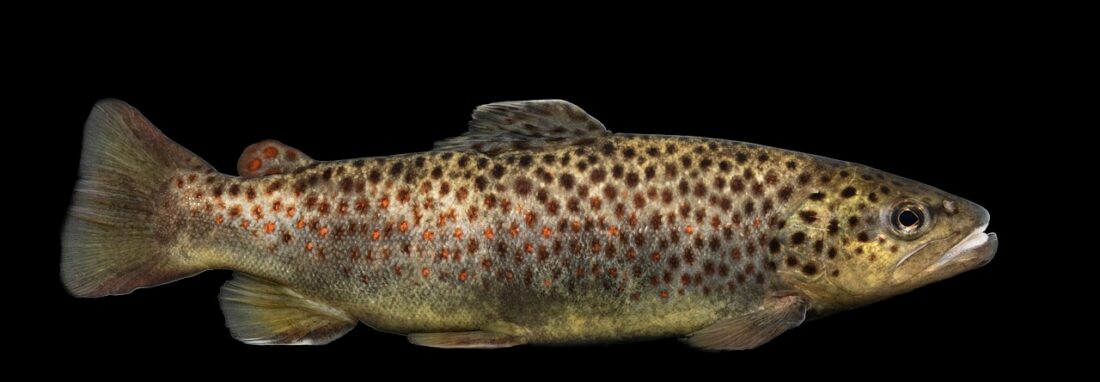
About the species Brown trout
How to recognise it
Adipose fin behind the dorsal, red spots with a pale edge along the sides and dark spots on the head. The body is brownish-gold.
Where it lives
Clean, cold, well-oxygenated streams and upper river reaches with a stony bed.
What it feeds on
Aquatic and falling insects, invertebrates and smaller fish.
Spawning
From October to January. The female digs a pit in the gravel, so it needs a clean gravel bed.
Sensitive to heat and lack of oxygen. It is caught on fly, nymph, spinner and natural baits.
Closed season, minimum size and daily limit
What the Fisheries Act says about brown trout. For guidance only; check it in the fishing regulations of the district.
Closed season
§ 10 of the Decree- 1 Sep – 15 Apr
this species may not be fishedoutside this period
It does not depend on the closed season for all fish by water type. You can find this and the other rules on the fishing district page in the Law and fishing rules section.
Minimum size
§ 12 of the Decree27 cm
below the size limit: return it to the waterfrom the size limit: you may keep it
You must not keep a fish shorter than 27 cm. The total length is measured from the front of the head to the end of the longest ray of the tail fin (§ 12, para. 4). The district user may raise the size; the one in the permit and the fishing regulations applies.
Daily limit
§ 14 of the Decree- 2pcsGreen groupeel, carp, burbot, zander, pike, tench, barbel, lake brown trout, brown trout, grayling (combined)
The limit applies per day, also when fishing in several districts. The district user may set a lower limit in the permit, in which case the stricter one applies.
Summary of Act no. 216/2018 Coll. and Decree no. 381/2018 Coll. (as of 6 Nov 2026). It may be out of date or contain an error, and exceptions apply on some waters. The permit and the fishing regulations of the district are binding. The fishing law, rule by rule.
Water temperature and requirements
At what temperature the species is active and how well today's water suits it.
Tolerates it, but slowed downTypical water on the Slovakia is 3.5 °C today. The species tolerates this temperature (1 to 20 °C), but the water is cooler than the ideal 6 to 16 °C. Fish are slower and more selective. This temperature corresponds to spawning (2 to 8 °C). Fishing restrictions apply during the closed season.
- tolerates 1 to 20 °C
- best 6 to 16 °C
- spawning at 2 to 8 °C
- typical water today 3.5 °C
- Length
- up to 140 cm
- Weight
- up to 50 kg
- Oxygen
- Requires a lot of oxygen
- Position in the food chain
- 3.9omnivore and small animals
The values are indicative and come from the FishBase database. In a particular water, fish behave according to the weather, air pressure, oxygen and food.
Where it was recorded
Fishing districts around which a record of this species exists (GBIF).
- Poprad č. 11
- Teplica č.1 (Turč. Teplice)
- Turiec č. 2(Turčian. Teplice)
- VN Červený Kláštor
- Varínka č. 1a
- Rybník Ďanová
- VN Nokle
- Váh č. 8
- Gaderský potok
- Necpalský potok
- Teplica č.2 (Turč. Teplice)
- Hornád č. 5c
- Veľká Biela Voda (NP Slovak Paradise)
- Blatnický potok
- Varínka č. 1b
15 fishing districts in total. Show on map
Catches of Brown trout
Approved catches by anglers on this portal.
Nobody has logged a catch of this species yet. Be the first; once approved it will appear here and on the leaderboard.
Similar species


Photo credits
- Brown trout: Photo: USFWS Mountain Prairie, Public domain, Wikimedia Commons
- Rainbow trout: Photo: This image originates from the National Digital Library of the United States Fish and W…, Public domain, Wikimedia Commons
- Grayling: Photo: Gilles San Martin, CC BY-SA 2.0, Wikimedia Commons
- Brook trout: Photo: Karelj, Public domain, Wikimedia Commons
Minimum sizes, protection periods and permitted fishing methods are set by the fishing regulations and the conditions of the specific fishing district. Check them before you fish.