Catalogue
Animals and plants by the water – species catalog
- Živočíchov
- 43
- Rastlín
- 12
- Chránených
- 21
- Hazards near the water
- 8
Game, birds, reptiles, amphibians, aquatic insects, plants by the bank and species to watch out for near the water. For each one you will find a description of where to look for it by the water, what it means for an angler, when it is most often observed and at which fishing districts it has already been recorded. None of this is counted in the fishing conditions score.
Species near the water
 Eurasian beaverCastor fiberA herbivore that changes the stream and its banks with dams and burrows. It is protected. It creates shallows and pools where fish and insects thrive.1,344 fishing districtsmost in January
 Black storkCiconia nigraA shy forest bird that nests in old forests and goes to streams and wetlands to hunt fish and frogs.1,400 fishing districtsmost in May
 Giant hogweedHeracleum mantegazzianumAn invasive plant that grows along stream banks and on wet meadows. In sunlight its sap causes skin burns.1,079 fishing districtsmost in July
 Black-headed gullChroicocephalus ridibundusThe most common gull by the water. Nests in colonies at ponds and large reservoirs and also stays along rivers.1,329 fishing districtsmost in May
 in season nowWild boarSus scrofaIt comes to the water to wallow and drink, mainly at dusk and at night.1,283 fishing districtsmost in October
 Black alderAlnus glutinosaA riparian tree whose roots reach below the water surface.1,400 fishing districtsmost in June
 in season nowMallardAnas platyrhynchosThe most common duck; it nests by almost every water with bankside vegetation.1,400 fishing districtsmostly April
 Castor bean tickIxodes ricinusTransmits tick-borne encephalitis and Lyme disease. It waits in tall grass and in the vegetation along banks.1,067 fishing districtsmost in October
 MosquitoesCulicidaeThey breed in standing water, so they are worst around reservoirs, oxbow lakes and floodplain forests, especially at sunset.1,093 fishing districtsmost in June
 Asian clamCorbicula flumineaAn Asian clam that is spreading along large rivers and is invasive.474 fishing districtsmostly April
 in season nowGreat cormorantPhalacrocorax carboA fish-eating bird. It nests at large reservoirs and in winter also stays on streams with open water.1,400 fishing districtsmost in December
 European pond turtleEmys orbicularisThe only native turtle in Slovakia. It lives in standing and slow waters with a soft bottom.351 fishing districtsmost in May
 Pond sliderTrachemys scriptaA non-native turtle from America that got into the wild from home pet keeping. It is invasive in Europe.756 fishing districtsmostly April
 Yellow flag irisIris pseudacorusA tall wetland plant with yellow flowers that grows on damp banks.1,400 fishing districtsmost in May
 in season nowMute swanCygnus olorA large white waterbird that nests by slow waters, reservoirs and ponds with vegetation.1,363 fishing districtsmostly April
 White water lilyNymphaea albaAn aquatic plant with large white flowers and floating leaves. It grows in clean standing waters.1,137 fishing districtsmost in July
 Yellow water lilyNuphar luteaAn aquatic plant with yellow flowers and floating and submerged leaves. It grows in both standing and slow-flowing waters.863 fishing districtsmost in August
 Brown bearUrsus arctosLives in the mountain forests of northern and central Slovakia. Near water it hunts fish and drinks.728 fishing districtsmost in June
 RaccoonProcyon lotorA predator from North America that has spread to Europe and is invasive. Near water it hunts for frogs, fish, crayfish, bird eggs and mollusks.42 fishing districtsmost in October
 Daubenton's batMyotis daubentoniiAt dusk it flies just above the surface and hunts aquatic insects, mainly midges and mayflies.704 fishing districtsmost in August
 Himalayan balsamImpatiens glanduliferaAn invasive plant from the Himalayas, up to two metres tall, with pink flowers. It overgrows the banks of watercourses.1,387 fishing districtsmost in August
 American minkNeogale visonAn invasive predator from America. It hunts fish, birds and amphibians by the water and threatens native species.
 MuskratOndatra zibethicusA rodent from North America that swims well and feeds on bankside plants. It digs burrows into the banks.561 fishing districtsmostly April
 in season nowWhite-tailed eagleHaliaeetus albicillaA large bird of prey that hunts fish at large reservoirs and rivers. In winter it gathers at water that does not freeze.1,400 fishing districtsmost in January
 HorsefliesTabanidaeLarge biting flies. They are most active on hot, windless days near water and on meadows.1,253 fishing districtsmost in July
 Broadleaf cattailTypha latifoliaA wetland plant with a brown cylindrical fruiting spike.1,400 fishing districtsmost in July
 Eurasian water shrewNeomys fodiensA small insectivore, an excellent swimmer and diver. It hunts aquatic invertebrates, young frogs and small fish.383 fishing districtsmost in July
 MayfliesEphemeropteraAn insect with aquatic larvae. Adults live only briefly and hatch all at once in swarms.1,399 fishing districtsmost in June
 Japanese knotweedReynoutria japonicaAn invasive herb from East Asia that forms dense stands up to three metres tall.1,400 fishing districtsmost in September
 StonefliesPlecopteraInsects whose larvae live in clean, cold, well-oxygenated streams.922 fishing districtsmost in May
 in season nowGreat crested grebePodiceps cristatusA diving waterbird with a crest on its head. Hunts small fish and insects, nests on a floating nest in the reeds.1,322 fishing districtsmost in May
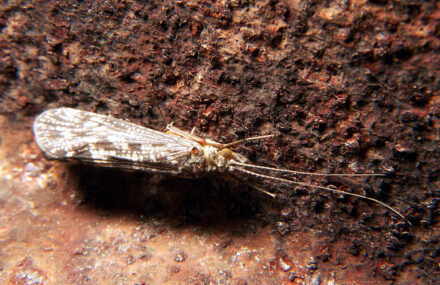 CaddisfliesTrichopteraInsects whose larvae, in many species, build protective cases from pebbles, sand or plants.1,273 fishing districtsmost in June
 Raccoon dogNyctereutes procyonoidesA canid from East Asia that has spread across Europe and is invasive. Near water it hunts for frogs, fish, bird eggs and mollusks.353 fishing districtsmost in July
 Noble crayfishAstacus astacusA native crayfish of clean streams and reservoirs. It is rare and endangered by crayfish plague and invasive crayfish.1,062 fishing districtsmost in August
 Signal crayfishPacifastacus leniusculusA North American crayfish that is invasive. It carries crayfish plague, which destroys native crayfish.138 fishing districtsmost in July
 Curled pondweedPotamogeton crispusA submerged plant with wavy leaves. Grows in still and flowing waters.1,331 fishing districtsmost in July
 Common toadBufo bufoThe largest native toad. In spring it migrates to water, where it breeds.1,400 fishing districtsmostly April
 HornwortCeratophyllum demersumA submerged plant without roots that floats in the water.1,270 fishing districtsmost in August
 in season nowCommon kingfisherAlcedo atthisA small bird that dives for little fish. It nests in steep banks of clean streams.1,400 fishing districtsmost in September
 in season nowEurasian lynxLynx lynxA hidden forest predator. It comes to the water for prey. Attacks on people are not known; an encounter is very unlikely.486 fishing districtsmost in August
 Fire salamanderSalamandra salamandraBlack with yellow spots. Lives in deciduous forests by clean mountain streams; the larvae develop in the stream.1,263 fishing districtsmost in May
 in season nowDuck musselAnodonta anatinaA large freshwater mussel that lives buried in the mud and sand of ponds and slow-flowing streams.601 fishing districtsmost in November
 Green frogs (water frogs)PelophylaxA group of green frogs that sit by the bank and jump into the water when disturbed.1,023 fishing districtsmost in May
 Zebra musselDreissena polymorphaA small mussel that attaches itself to stones and other solid objects. It is invasive and comes from the Black Sea region.568 fishing districtsmost in August
 Common reedPhragmites australisTall grass that forms extensive reed beds around ponds and on banks.1,400 fishing districtsmost in August
 Grass snakeNatrix natrixA harmless snake with two yellow spots on the nape. It swims well and hunts frogs, fish and newts.1,400 fishing districtsmost in May
 DragonfliesOdonataPredatory insect. The larvae live underwater for several months to years; adult dragonflies hunt in the air above the water.1,400 fishing districtsmost in June
 Gray wolfCanis lupusA shy predator of the forests. It comes to the water at night and at dusk.886 fishing districtsmost in August
 White-throated dipperCinclus cinclusA small bird that dives and runs along the bed of rapids after insect larvae. Nests by clean mountain streams.1,028 fishing districtsmost in June
 in season nowGreat egretArdea albaA large white heron that hunts fish and frogs in the shallows. In Slovakia its numbers are rising, and in winter it can also be seen by watercourses.1,400 fishing districtsmost in May
 in season nowGrey heronArdea cinereaIt stands in the shallows and lies in wait for small fish. It is easy to see along the banks of ponds and slow streams.1,400 fishing districtsmost in May
 White willowSalix albaA tree on the banks of rivers and ponds. Its branches shade the water and its roots hold the bank.1,008 fishing districtsmost in July
 Common viperVipera berusA venomous snake that basks on rocky slopes, in wetlands and at forest edges near water.642 fishing districtsmost in May
 in season nowEurasian otterLutra lutraIt hunts fish, crayfish and frogs. It is strictly protected, and its presence is considered a sign of fairly clean water with plenty of fish.1,010 fishing districtsmost in November
 Common duckweedLemna minorA tiny floating plant that can cover the whole surface of standing water.1,400 fishing districtsmost in August
No species was found for this search.
Photo credits
- Eurasian beaver: Photo: Per Harald Olsen, CC BY-SA 3.0, Wikimedia Commons
- Black stork: Photo: Chris Eason, CC BY 2.0, Wikimedia Commons
- Giant hogweed: Photo: Lucas Kendall, CC BY-SA 4.0, Wikimedia Commons
- Black-headed gull: Photo: Hans Hillewaert, CC BY-SA 3.0, Wikimedia Commons
- Wild boar: Photo: Valentin Panzirsch, CC BY-SA 3.0 at, Wikimedia Commons
- Black alder: Photo: AnRo0002, CC0, Wikimedia Commons
- Mallard: Photo: This picture was realized by Richard Bartz by using a Canon EF 70-300mm f/4-5.6 IS USM…, CC BY-SA 2.5, Wikimedia Commons
- Castor bean tick: Photo: W.alter, CC BY-SA 4.0, Wikimedia Commons
- Mosquitoes: Photo: Katja Schulz from Washington, D. C., USA, CC BY 2.0, Wikimedia Commons
- Asian clam: Photo: Ryan Hodnett, CC BY-SA 4.0, Wikimedia Commons
- Great cormorant: Photo: MPF, CC BY-SA 4.0, Wikimedia Commons
- European pond turtle: Photo: Christian Ursilva from København, Danmark, CC BY-SA 4.0, Wikimedia Commons
- Pond slider: Photo: Happyswissman, CC BY 3.0, Wikimedia Commons
- Yellow flag iris: Photo: Myrabella, CC BY-SA 3.0, Wikimedia Commons
- Mute swan: Photo: Sanchezn, CC BY-SA 3.0, Wikimedia Commons
- White water lily: Photo: Jacek Halicki, CC BY-SA 4.0, Wikimedia Commons
- Yellow water lily: Photo: author not stated, CC BY-SA 2.0 de, Wikimedia Commons
- Brown bear: Photo: Yathin S Krishnappa, CC BY-SA 3.0, Wikimedia Commons
- Raccoon: Photo: Rhododendrites, CC BY-SA 4.0, Wikimedia Commons
- Daubenton's bat: Photo: Gilles San Martin from Namur, Belgium, CC BY-SA 2.0, Wikimedia Commons
- Himalayan balsam: Photo: H. Zell, CC BY-SA 3.0, Wikimedia Commons
- American mink: Photo: Needsmoreritalin, CC BY-SA 3.0, Wikimedia Commons
- Muskrat: Photo: D. Gordon E. Robertson, CC BY-SA 3.0, Wikimedia Commons
- White-tailed eagle: Photo: Bengt Nyman from Vaxholm, Sweden, CC BY-SA 2.0, Wikimedia Commons
- Horseflies: Photo: Bruce Marlin, CC BY-SA 2.5, Wikimedia Commons
- Broadleaf cattail: Photo: Peter O'Connor aka anemoneprojectors from Stevenage, United Kingdom, CC BY-SA 2.0, Wikimedia Commons
- Eurasian water shrew: Photo: Accipiter (R. Altenkamp, Berlin), CC BY-SA 3.0, Wikimedia Commons
- Mayflies: Photo: Richard Bartz, Munich aka Makro Freak Image:MFB.jpg, CC BY-SA 2.5, Wikimedia Commons
- Japanese knotweed: Photo: W.carter, CC0, Wikimedia Commons
- Stoneflies: Photo: JJ Harrison (https://www.jjharrison.com.au/), CC BY-SA 3.0, Wikimedia Commons
- Great crested grebe: Photo: JJ Harrison (https://www.jjharrison.com.au/), CC BY-SA 3.0, Wikimedia Commons
- Caddisflies: Photo: Bruce Marlin, CC BY-SA 2.5, Wikimedia Commons
- Raccoon dog: Photo: Ryzhkov Sergey, CC BY-SA 4.0, Wikimedia Commons
- Noble crayfish: Photo: Dragon187, CC BY-SA 3.0, Wikimedia Commons
- Signal crayfish: Photo: Astacoides, CC BY-SA 3.0, Wikimedia Commons
- Curled pondweed: Photo: author not stated, CC BY-SA 3.0, Wikimedia Commons
- Common toad: Photo: Tythatguy1312, CC BY-SA 4.0, Wikimedia Commons
- Hornwort: Photo: Bernd Haynold, CC BY-SA 3.0, Wikimedia Commons
- Common kingfisher: Photo: Tony Wood, CC BY 2.0, Wikimedia Commons
- Eurasian lynx: Photo: Aconcagua (talk), CC BY-SA 3.0, Wikimedia Commons
- Fire salamander: Photo: Didier Descouens, CC BY-SA 4.0, Wikimedia Commons
- Duck mussel: Photo: User:Weitbrecht, CC BY-SA 3.0, Wikimedia Commons
- Green frogs (water frogs): Photo: Charles J. Sharp, CC BY-SA 4.0, Wikimedia Commons
- Zebra mussel: Photo: Smithsonian Environmental Research Center, CC BY 2.0, Wikimedia Commons
- Common reed: Photo: W.carter, CC0, Wikimedia Commons
- Grass snake: Photo: Charles J. Sharp, CC BY-SA 4.0, Wikimedia Commons
- Dragonflies: Photo: Paul Balfe, CC BY 2.0, Wikimedia Commons
- Gray wolf: Photo: User:Mas3cf, CC BY-SA 4.0, Wikimedia Commons
- White-throated dipper: Photo: Mark Medcalf, CC BY 2.0, Wikimedia Commons
- Great egret: Photo: Chuck Homler (FocusOnWildlife.Me), CC BY-SA 4.0, Wikimedia Commons
- Grey heron: Photo: Giacomo Cimino (foto.giacomocimino.workers.dev · @giacomociminoph), CC BY-SA 4.0, Wikimedia Commons
- White willow: Photo: MPF, CC BY-SA 3.0, Wikimedia Commons
- Common viper: Photo: Charles J. Sharp, CC BY-SA 4.0, Wikimedia Commons
- Eurasian otter: Photo: Bernard Landgraf, CC BY-SA 3.0, Wikimedia Commons
- Common duckweed: Photo: author not stated, CC BY-SA 3.0, Wikimedia Commons
The occurrence is based on observations in the GBIF database. It shows where people have recorded the species, not where it is certain to be or how many there are. The advice is general and does not replace the instructions of a doctor, rescuers, the area manager or the fishing regulations.