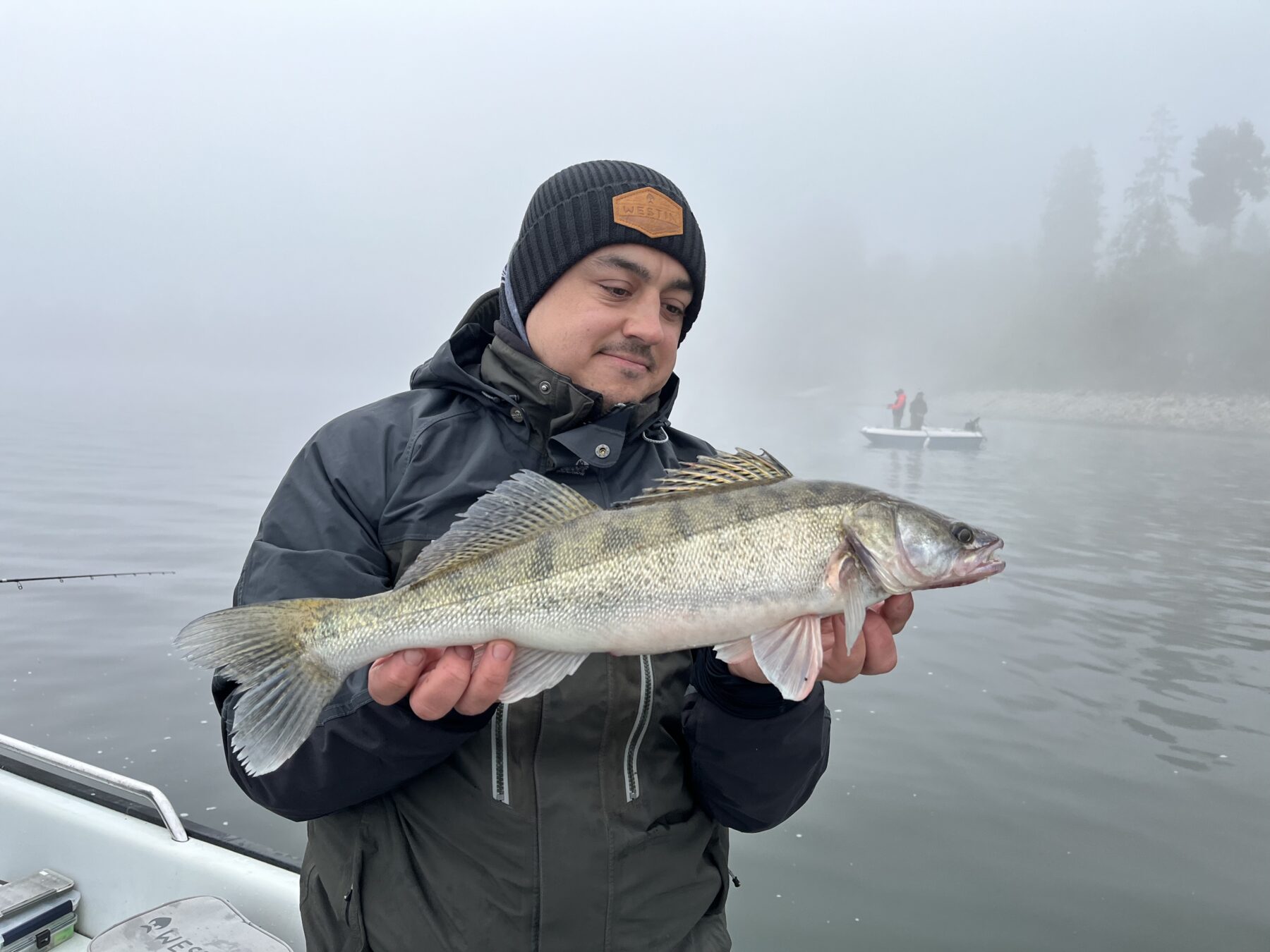
How this catch ranks
- In the 2026 season#1the first catch in this selection
- Among the same species#1the first catch in this selection
- At VN Orava#1the first catch in this selection
Badges for this catch
- Zander (pikeperch)
- Predators
- Three-kilo fish
- Misty fishing
- High pressure
- At full moon
- Pioneer
- Beginner
- Carp water
- Still water
- Spinning angler
- Decent fish
- One-kilo fish
- Released
- Early bird
- Autumn catch
- First photo
How the session went
From the start of fishing to the photo, with sunrise and sunset that day.
- Start of fishing05:45
- 1 h 05 minWaiting for the biteBite06:50
- 5 minPlaying the fishLanding06:55
- 60 sFrom landing to the photoPhoto06:56
- Whole session1 h 11 min
- Time of day at the biteGolden hour6 min after sunrise
About the species Zander (pikeperch)
Basic information from the fish catalogue. Sizes and temperatures come from the FishBase database; the figures for this catch are a comparison with them.

Fish, perch family
- Maximum lengthup to 130 cmthis catch is 42 % of the maximum
- Maximum weightup to 20 kgthis catch is 16 % of the maximum
- Best water temperature14–25 °Cthe water at the catch (14.0 °C) was in the ideal range
How to recognise it
Two dorsal fins, the first with spines. Large glassy eyes and a pair of distinct fangs in the mouth. The sides have dark stripes.
Where it lives
Deeper reservoirs and lowland rivers with murkier water, often near deep holes and sunken trees.
What it feeds on
Mainly fish, fry and insects.
Spawning
In April and May. The male guards the nest on roots or gravel.
It is most active at dusk and at night. It has a soft mouth, so do not jerk when striking.
Conditions at the moment of the catch
Conditions at the time of the bite, read from portal data when the catch was logged.
Portal activity index at the time of the biteRecalculated from measured data. The index is an indicative estimate by the portal, not a measurement, and guarantees nothing.
- Air1.5 °C
- Pressure1 034 hPasteady (-0.3 hPa in 3 h)
- Wind4 km/hfrom N, gusts 5 km/h
- Cloud cover100%
- Water14.0 °Centered by the angler
- Water according to the portal9.1 °Cestimated from the air temperature
What the index is made of
The base of 31 points is set by the water temperature; the other factors shift it.
- +1Pressuresteady (-0.3 hPa/3 h)Steady pressure is usually favourable according to anglers; studies have not confirmed it.
- −2Pressure level1 034 hPaVery high pressure.
- +1Windweak, 4 km/hA light wind ripples the surface and brings food to the bank (anglers' experience).
- +6Svetlogolden hourAt sunrise and sunset many species feed more actively, and the low light gives predators an advantage.
- +2Monthsolunar periodSolunar theory has no confirmation in studies; it is a small hypothesis.
- −6Water clarity≈ 76 FNU, satellite 31 OctVery turbid water: visibility is short and sight fishing is difficult.
- 0ChlorophyllModerate chlorophyll, NDCI 0.02, satellite 31 OctNo sign of a bloom.
- 0OvergrowthClean surface, 0% of the area, satellite 31 OctOpen water surface, fishing is not limited by vegetation.
- −1Nitrogen in groundwater (SHMÚ)nitrates typically 5.9 mg/l (standard 50), ammonium above the standard at 2 of 5 stationsGroundwater reaches streams as base flow and carries nitrogen from fields and waste. Nitrates feed algae and contribute to nighttime oxygen crashes; nitrites are toxic to fish. Nitrites and ammonium can also be natural in deep groundwater, so at most one point is deducted for them. The data reliability is 100% (5 stations within 10 km, nearest 1.3 km, data from 2025), and the adjustment was applied in full.
- 0Aquatic insect hatches0.2× the average month, 1 of 70 observations in the year, iNaturalistAquatic insects are scarce this month; food near the bottom matters more.
How conditions changed during the session
| Data | Start of fishing | Bite | Landing | Photo |
|---|---|---|---|---|
| Time | 05:45 | 06:50 | 06:55 | 06:56 |
| Air | 1.7 °C | 1.5 °C | 1.5 °C | 1.5 °C |
| Pressure | 1 034 hPa | 1 034 hPa | 1 034 hPa | 1 034 hPa |
| Wind | 3 km/h NE | 4 km/h N | 4 km/h N | 4 km/h N |
| Cloud cover | 97% | 100% | 100% | 100% |
| Water (entered by the angler) | 14.0 °C | 14.0 °C | 14.0 °C | 14.0 °C |
| Water (estimated from air temperature) | 9.1 °C | 9.1 °C | 9.1 °C | 9.1 °C |
| Activity index | 26 | 32 | 32 | 32 |
The day of the catch in numbers
Hours before and after the bite, based on hourly weather data.
19 to 32 out of 100
1,032 to 1,035 hPa
1.5 to 19.8 °C
1 to 8 km/h
- bite
- start of fishing
- night
Sun, Moon and solunar
Calculated for the district's location and the time of the bite.
- Sunrise06:44
- Sunset18:16
- Day length11 h 32 min
- MonthLast quarter58% illuminated, day 21 of the lunar cycle
- Moonrise22:36
- Moonset15:02
Solunar windows that day
- 05:16 – 07:16Major windowMoon at its highestthe bite came in this window
- 14:32 – 15:32Minor windowMoonset
- 17:47 – 19:47Major windowMoon underfoot
- 22:06 – 23:06Minor windowMoonrise
Solunar theory is not scientifically proven, so the windows are only a minor addition to the activity index.